
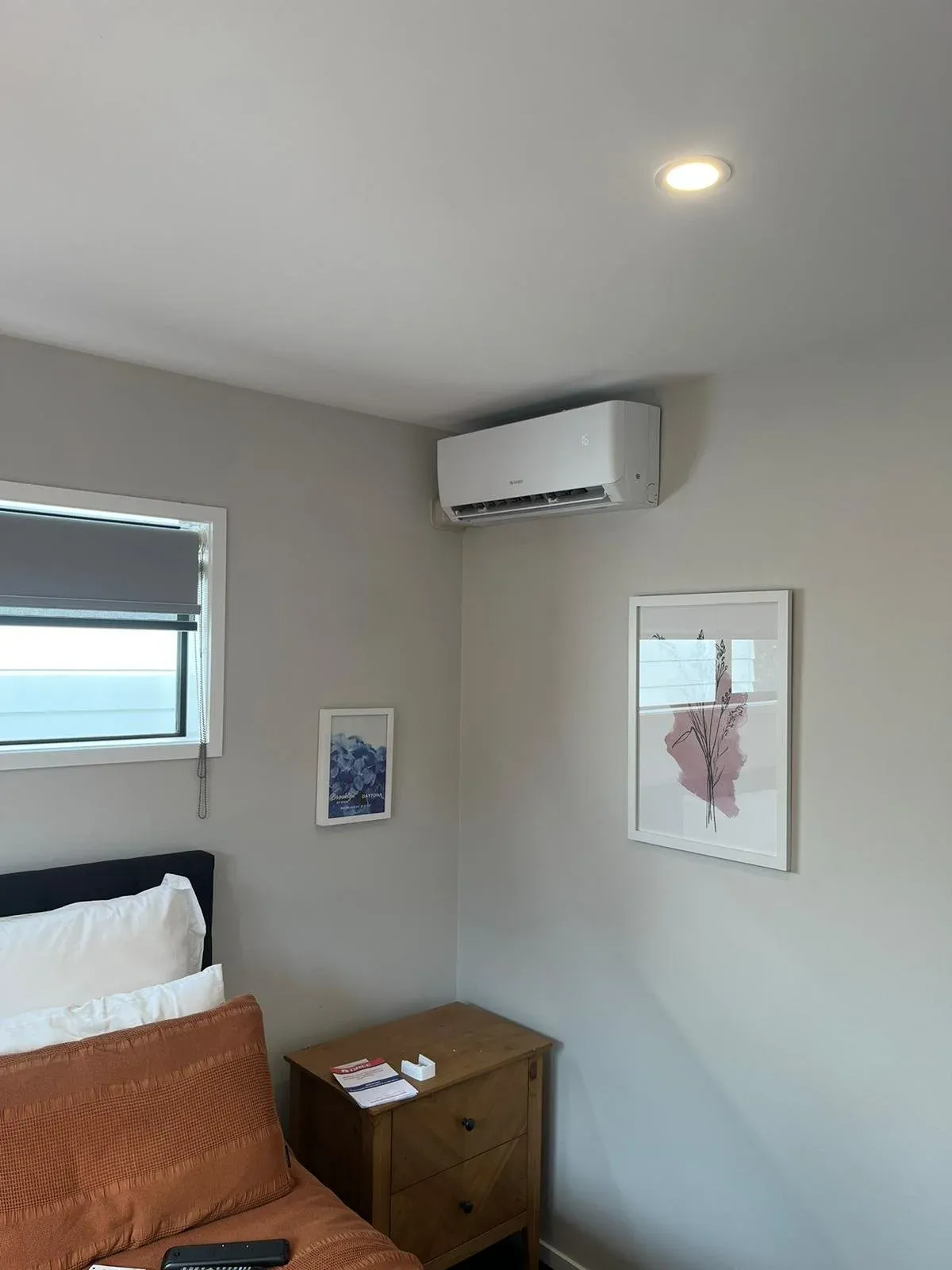
Some smaller high-wall heat pumps can run at around 18 to 21 dB(A) on their quietest indoor fan setting, depending on the model and the mode. Larger units are generally louder. So correct sizing, placement and installation quality matter just as much as the number on the brochure.
Here is how to think about noise when you are choosing a heat pump for an Auckland home.
1. Why quiet matters more than it used to
Auckland winters are damp and mild rather than freezing, so a heat pump tends to run for long stretches at low output rather than blasting on and off. That is good for your power bill. It also means the unit is on, in the background, for hours at a time.
More people are working from home. More homes are open plan, so the living area unit is heard from the kitchen and often from a bedroom. A heat pump that is fine in a showroom can be the loudest thing in a quiet house at nine in the evening.
2. How quiet is quiet?
Noise ratings are measured on the lowest indoor fan setting, in ideal conditions. Real rooms are not ideal. Use these as a guide to what is realistic, not as a promise.
| Room or application | Typical quiet indoor sound level | What to expect |
|---|---|---|
| Bedrooms, home offices and small rooms, about 2.5 to 3.5 kW | About 18 to 21 dB(A) | Some smaller high-wall units are extremely quiet on their lowest fan setting. This is the range that suits a room where noise really matters. |
| Medium living areas, about 4.0 to 6.0 kW | About 25 to 30 dB(A) | Still very quiet in normal use, but not as low as the smallest bedroom units. Sizing and placement start to matter more. |
| Large open-plan areas, about 7.0 to 9.0 kW and above | About 29 to 36 dB(A) | Bigger units move more air, so they make more noise. Placement, sizing and installation quality are what keep them comfortable. |
At the quiet end of that first row, a heat pump is quieter than a whisper in a still room. At the top of the third row it is closer to a fridge humming in the next room.
One thing worth knowing. The quietest figure a manufacturer publishes is almost always the lowest fan speed in a specific mode. If the unit is undersized for the room it will rarely get to run that slowly, because it will be working hard to keep up. An undersized heat pump is a loud heat pump, whatever its rating says.
3. Getting the size right is the real trick
Sizing is where most noise complaints actually start.
- Too small and the unit runs at high fan speed most of the time to hold the temperature. You hear it constantly and it costs more to run.
- Too big and it heats the room quickly then stops, over and over. You notice it starting and stopping, and the temperature swings.
- Right sized and it settles into a long, slow, quiet run. That is the setting the low noise figures are measured at.
Sizing depends on more than floor area. Ceiling height, insulation, how much glazing you have and which way it faces, whether the space is open to a hallway or a stairwell, and how airtight the house is. A 40 square metre lounge in a 1920s villa is a different job from a 40 square metre lounge in a new build. Property layout, access and what the installation itself needs all feed into it as well. That is why the final recommendation and the quote come from looking at the property, not from room size alone.
4. Placement changes what you hear
Two identical units in the same room can sound different.
- Indoor unit. Height, and how close it is to a hard wall or ceiling, changes how sound reflects. Blowing straight down a hallway carries sound further than blowing across a room.
- Outdoor unit. This is the one neighbours notice. Under a bedroom window, in a narrow side passage, or in a corner where two walls meet, the sound bounces and builds. A little more space around it and a sensible mounting position makes a real difference.
- Mounting. A poorly secured bracket transmits vibration into the wall framing. The unit itself can be quiet and the wall can still buzz.
None of this costs more to get right on the day. It costs a lot to fix afterwards.
5. What to look for in an Auckland installer
The install matters as much as the box. Here is what to check before you book anyone.
- Correct sizing advice, in writing. Ask how they arrived at the kW rating. If nobody has asked about your ceiling height, insulation or glazing, they have guessed.
- Qualified and licensed technicians. Electrical work must be completed by a registered electrical worker, and refrigerant work should be carried out by appropriately trained and licensed HVAC technicians.
- A clear quote. The unit, the installation, the electrical work, and anything specific to your place such as a long pipe run or difficult access. No surprises after the fact.
- A tidy installation. Pipe runs planned rather than improvised, brackets properly fixed, and the outdoor unit sited with some thought about noise.
- Commissioning. The system should be tested, charged correctly and handed over working, with someone showing you how to run it.
- After-sales support. Who services it, who handles a warranty claim, and how you reach them.
Getting it right the first time
The quietest heat pump in the country will still annoy you if it is the wrong size for the room, mounted on a wall that carries vibration, or pointed down a hallway. Get the sizing and the placement right and a well chosen unit disappears into the background, which is exactly what you want.
If you would like advice on the right system for your home, or a quote for supply and installation, talk to the team at Trident. We install Mitsubishi Electric, Daikin and Panasonic heat pumps across Auckland for both residential and commercial customers, and we will size the system properly before we quote it.
Need help sizing or choosing a quiet heat pump?
Get in touch with Trident today. We provide clear, fixed quotes and expert sizing across Auckland.